

MSc, Psih. Eusebiu Jean TIHAN[1], MSc, Psih. Mihaela Laura TIHAN[2]
eusebiu.tihan@gmail.com
[1] Academia Oamenilor de Știință – România, ORCID: 0009-0008-8316-3679
[2] Tihan & Associates, Professional Civil Society of Psychology, Bucharest, Romani, ORCID: 0009-0003-1820-1417
Abstract
This article examines the position and functioning of the Romanian Ombudsman institution through the lens of an extended triadic model of social integration: Anarchy (absence of order), Gesellschaft (contractual society based on rule of law), and Oligarchic Gemeinschaft (closed community based on institutional capture). The study employs a qualitative institutional analysis and case study methodology, integrating theoretical synthesis of the Hardware-Software model with critical examination of the Ombudsman’s activity in the post-2020 period. The research demonstrates that in contemporary Romania, the Ombudsman institution has undergone a transition from a potential pillar of Gesellschaft to an instrument legitimizing Oligarchic Gemeinschaft. The politicized appointment mechanism and the profile of the office-holder elected in 2023 evidence initial capture. Activity analysis reveals a behavioral pattern characterized by: strategic passivity in cases touching power interests, symbolic activity in neutral domains, and counterproductive action against Gesellschaft (attacks on courts and integrity mechanisms). The institution thus functions as a “guardian of capture,” diluting state accountability and providing formal legitimacy to a drifting system. The article concludes that the fate of a citizen protection institution serves as a diacritical indicator of a political system’s health. Restoring its authentic function requires not cosmetic reforms but radical revision of its appointment mechanism and accountability to society, realigning it with the fundamental principles of the rule of law.
Keywords: Ombudsman, institutional capture, Oligarchic Gemeinschaft, Gesellschaft, politicization, Romania, rule of law, institutional theory, anarchy-society-community triad.
Sentinela capturată: Instituția ombudsmanului în triada anarhie – gesellschaft – gemeinschaft. O analiză a poziționării instituționale în România post-2020
Rezumat
Acest articol examinează poziția și funcționarea instituției Ombudsmanului din România prin prisma unui model triadic extins de integrare socială: Anarhie (absența ordinii), Gesellschaft (societate contractuală bazată pe statul de drept) și Gemeinschaft oligarhică (comunitate închisă bazată pe capturarea instituțională). Studiul utilizează o analiză instituțională calitativă și o metodologie de studiu de caz, integrând sinteza teoretică a modelului Hardware-Software cu o examinare critică a activității Ombudsmanului în perioada de după 2020. Cercetarea demonstrează că, în România contemporană, instituția Ombudsmanului a trecut printr-o tranziție de la un potențial pilon al Gesellschaft la un instrument de legitimare a Gemeinschaft-ului oligarhic. Mecanismul de numire politizat și profilul titularului funcției ales în 2023 evidențiază o capturare inițială. Analiza activității relevă un model comportamental caracterizat prin: pasivitate strategică în cazurile care ating interesele puterii, activitate simbolică în domenii neutre și acțiuni contraproductive împotriva Gesellschaft (atacuri asupra instanțelor și a mecanismelor de integritate). Instituția funcționează astfel ca un „gardian al capturării”, diluând responsabilitatea statului și conferind legitimitate formală unui sistem în derivă. Articolul concluzionează că soarta unei instituții de protecție a cetățenilor servește drept indicator diacritic al sănătății unui sistem politic. Restabilirea funcției sale autentice necesită nu reforme cosmetice, ci o revizuire radicală a mecanismului său de numire și a responsabilității față de societate, realiniindu-l la principiile fundamentale ale statului de drept.
Cuvinte cheie: Ombudsman, captură instituțională, Gemeinschaft oligarhică, Gesellschaft, politizare, România, statul de drept, teoria instituțională, triada anarhie-societate-comunitate.
INTELLIGENCE INFO, Volumul 5, Numărul 4, Decembrie 2026, pp. xxx
ISSN 2821 – 8159, ISSN – L 2821 – 8159, DOI: 10.58679/II56403
URL: https://www.intelligenceinfo.org/en/the-captured-sentinel-the-ombudsman/
© 2026 Eusebiu Jean TIHAN, Laura Mihaela TIHAN. Responsabilitatea conținutului, interpretărilor și opiniilor exprimate revine exclusiv autorilor.
CC BY 4.0 License
1. INTRODUCTION: THE OMBUDSMAN – BETWEEN SHIELD OF THE CITIZEN AND SHIELD OF POWER
The institution of the Ombudsman occupies a paradoxical position in the architecture of the modern democratic state. On one hand, it is a quintessential creation of rational Gesellschaft: a formal, impersonal, and procedural mechanism designed to remedy bureaucratic deficiencies and protect the individual against administrative arbitrariness (Harlow & Rawlings, 2009). It embodies the ideal that the state is not an oppressive monolith but a system capable and obliged to self-correct through non-jurisdictional institutional channels accessible to all citizens. Institutional sentinel, mediator, guardian of rights – all these metaphors suggest an actor whose loyalty is ultimately to law and citizen, not to the government of the day.
On the other hand, precisely this position of independent guardian makes the Ombudsman a particularly valuable target for forces seeking to capture the state. In a system sliding from Gesellschaft toward Oligarchic Gemeinschaft, control over this institution offers three capital benefits to the oligarchy: (1) the capacity to neutralize a potential point of resistance that might denounce systemic abuses; (2) the possibility of instrumentalizing its moral and juridical authority to attack other institutions still resisting capture (e.g., an independent judiciary); and (3) the provision of a human face and formal legitimation to the entire system, enabling it to claim that checks and balance mechanisms remain functional.
This paradox is not merely theoretical. Across Central and Eastern Europe, and particularly in Romania, we witness a phenomenon that transcends isolated institutional dysfunction. What emerges is a systematic pattern: institutions designed as bulwarks against state capture are themselves being captured and reprogrammed to serve the very interests they were meant to constrain. The Ombudsman – the “people’s advocate” – becomes, in this process, a particularly instructive case study precisely because its mission is so intimately tied to the protection of the vulnerable against the powerful. When the shield of the citizen is transformed into the shield of power, we are not witnessing a simple administrative failure. We are witnessing a constitutional pathology of the first order.
The purpose of this article is to dissect this paradox, bringing the Romanian Ombudsman institution under the lens of the triadic model Anarchy – Gesellschaft – Oligarchic Gemeinschaft. We seek to answer the question: As specialized “Normative Software” for protection, is the Ombudsman an authentic product of Gesellschaft, a neutral actor suffering pressures in a degraded system, or has it already become an active instrument of Oligarchic Gemeinschaft?
To accomplish this, the article is structured as follows: Section 2 recapitulates and extends the theoretical framework, positioning the institution within the triadic model. Section 3 examines the mechanism of appointment as the critical determinant of future positioning. Section 4 offers an analytical case study of the Romanian Ombudsman’s activity in the post-2020 period, with emphasis on the mandate beginning in 2023. Section 5 synthesizes observed institutional behavioral patterns and relates them to the three states of the triad. Finally, Section 6 extracts conclusions regarding the significance of this institution’s capture for the overall diagnosis of the Romanian political system and proposes directions for reform and future research.
2. THEORETICAL POSITIONING: THE OMBUDSMAN IN THE ANARCHY – GESELLSCHAFT – GEMEINSCHAFT TRIAD
2.1. Conceptual Foundations: From Tönnies to Contemporary Institutional Theory
To understand the trajectory of an institution, we must first understand its ideal habitat and its pathological ones. Ferdinand Tönnies’ (1887/2001) foundational distinction between Gemeinschaft (community) and Gesellschaft (society) provides the conceptual architecture for such an understanding. For Tönnies, Gemeinschaft is characterized by organic will, emotional bonds, traditional status, and closed, particularistic relationships rooted in kinship, neighborhood, and friendship. Gesellschaft, by contrast, is characterized by rational will, contractual relations, achieved status, and open, universalistic relationships mediated by law, exchange, and calculated interest.
This nineteenth-century sociological framework has been revitalized and extended by contemporary institutional theorists. Douglass North, John Wallis, and Barry Weingast (2009) distinguish between “limited access orders” (natural states) and “open access orders.” In the former, social order is maintained through the creation of rents and the formation of dominant coalitions that restrict access to organizational forms; in the latter, order is maintained through competition, rule of law, and widespread access to political and economic organizations. The resonance with Tönnies’ distinction is striking: Gemeinschaft corresponds to the limited access order, Gesellschaft to the open access order.
Alina Mungiu-Pippidi (2015) further refines this framework for the study of governance and corruption. She distinguishes between particularism – the distribution of public goods based on particular relationships and membership in privileged groups – and universalism – the distribution of public goods based on impersonal, transparent, and meritocratic criteria. The transition from particularism to universalism, she argues, is the central challenge of good governance.
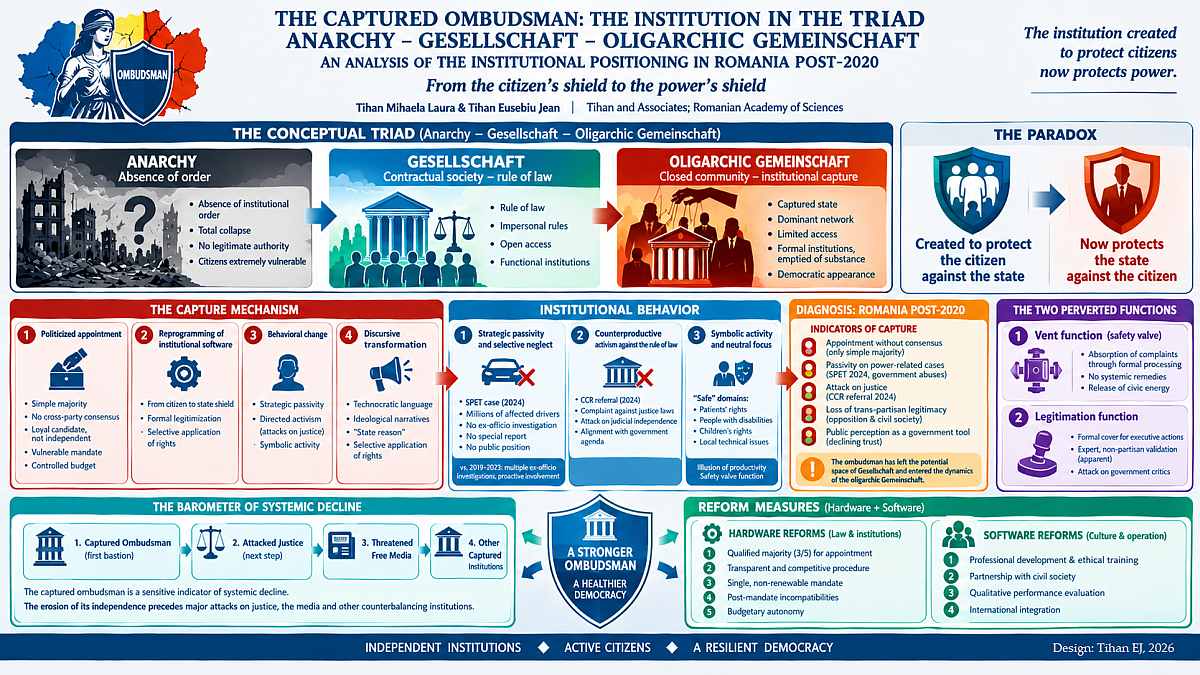
Building on these foundations, we propose an extended triadic model that introduces a third state – Anarchy – and refines the Gemeinschaft category to capture its contemporary, post-communist, oligarchic manifestation. The triad thus becomes:
- Anarchy (State of Nature/Institutional Collapse): Absence of ordered governance. No legitimate monopoly on violence exists, or if a nominal authority exists, it lacks power, respect, and resources. Institutions are either non-existent or completely inoperative.
- Gesellschaft (Contractual Society and Rule of Law): Open access order characterized by impersonal rules, competitive markets, independent judiciary, and universalistic governance. Institutions function according to their formal mandates.
- Oligarchic Gemeinschaft (Closed Community and State Capture): A pathological, post-formalist state in which the institutional shell of Gesellschaft persists, but its substance has been hollowed out and reprogrammed. Formal democratic institutions continue to exist but are subordinated to the logic of a closed network. Access is limited not by law but by membership in the dominant coalition.
This triadic model is not teleological; societies do not inevitably progress from Anarchy through Gesellschaft to Oligarchic Gemeinschaft, nor do they necessarily move in one direction. Rather, the model provides a diagnostic grid for locating institutions and systems along three qualitatively distinct states of social order.
2.2. The Ombudsman in Its Ideal-Typical State: Gesellschaft Functionality
In its Gesellschaft ideal-type, the Ombudsman institution exhibits five defining characteristics:
First, Legitimation Through and For Law. The institution is established by and operates strictly within the framework of law. Its mandate is clearly defined, and its attributions are exercised to ensure concordance between administrative action and superior juridical norms. The Ombudsman is not a political actor but a juridical one; its authority derives not from electoral victory but from constitutional delegation and professional competence.
Second, Radical Independence from Executive Power. The Ombudsman is appointed by Parliament, typically through a qualified or consensual majority, for a long, fixed, non-renewable term removable only in grave circumstances specified by law. The institution receives no orders from the government; its budget is autonomous; its staff is professionally selected and protected. This structural independence is not a privilege of the office-holder but a right of the citizenry, ensuring that the advocate owes no allegiance to those it must investigate.
Third, Impartiality and Universalism. The Ombudsman intervenes to defend anyone suffering administrative abuse, regardless of status, political affiliation, or popularity. Its software is programmed with universal principles: equal treatment, non-discrimination, procedural fairness, proportionality. The identity of the wrongdoer is irrelevant; the violation of law is what matters.
Fourth, Moral Authority and Soft Power. The Ombudsman’s power is generally not coercive; it does not issue enforceable judgments. Its effectiveness rests on the quality of its investigations, the irrefutability of its juridical reasoning, the publicity of its actions, and the moral authority of its office-holder. Its efficiency is measured by its capacity to persuade and to induce administration to self-correct. This soft power is paradoxically its greatest strength; an Ombudsman that must rely on courts to enforce its recommendations has already failed in its primary mission.
Fifth, Systemic Integration Function. The Ombudsman acts as a “thermostat” of the system, detecting dysfunctions and pressing for remedies, thereby consolidating citizens’ trust in the rule of law (Schedler, Diamond & Plattner, 1999). It is not merely a complaint-processing mechanism but an early warning system for systemic failures, a source of recommendations for legislative and administrative reform, and a symbol of the state’s commitment to self-restraint and accountability.
2.3. The Ombudsman in Pathological State: Oligarchic Gemeinschaft Instrumentalization
In the pathological state of Oligarchic Gemeinschaft, the Ombudsman undergoes a fundamental metamorphosis. From an institution controlling executive power, it transforms into an institution legitimating and protecting executive power. This transformation is accomplished through four interconnected mechanisms:
First, Capture of the Appointment Process. The office-holder is selected through a politicized procedure, typically with a simple partisan majority, ensuring that the appointed person is loyal to the power network rather than to the principle of rule of law. A “safe” profile is sought, not an independent one. The ritual of appointment becomes a ceremony of cooptation.
Second, Functional Reversal: From Control to Legitimation. The institution begins to be used to provide a cover of legality and public morality for executive actions. It may issue reports that minimize abuses or attack other institutions that disturb the oligarchy. Its juridical expertise, rather than being deployed against the state on behalf of citizens, is deployed against citizens and independent institutions on behalf of the state.
Third, Strategic Passivity and Symbolic Activity. The institution becomes passive or ineffective in investigating serious abuses committed by actors within the power network. Conversely, it is active in symbolic or technical domains that do not threaten the system’s core, thereby maintaining an appearance of utility while abdicating its central mission. This selective activation and deactivation of institutional capacity is not random; it follows the logic of network protection.
Fourth, Discursive Transformation. The institution’s language shifts from juridical-technocratic, universalist discourse to particularist and ideological discourse. It may begin to justify abuses through appeals to “reasons of state,” “stability,” “national sovereignty,” or attacks on “foreign interests.” The vocabulary of rights is not abandoned but repurposed; the Ombudsman may speak of rights while systematically failing to protect them when their violation serves the oligarchy.
In essence, in Oligarchic Gemeinschaft, the Ombudsman is no longer a sentinel looking outward to protect the citizen from the state. It turns its weapons inward to protect the oligarchic core from citizens and from institutions that still resist. It becomes an instrument for managing protest and neutralizing criticism through pseudo-legal channels – a sophisticated form of spoiling hope in justice.
2.4. The Hardware-Software Model of Institutional Analysis
To operationalize this triadic framework for empirical research, we introduce the Hardware-Software model of institutional analysis. This model distinguishes between two dimensions of institutional existence:
Institutional Hardware comprises the visible, formal, structural elements: the constitutional and legal provisions establishing the institution, its formal mandate, its organizational chart, its budget, its physical infrastructure, the formal qualifications for office, the procedural rules for appointment and removal. Hardware can be observed in official documents; it is what the institution is on paper.
Institutional Software comprises the invisible, informal, cultural-operational elements: the mentalities, values, and professional ethics of office-holders and staff; the unwritten rules and daily working routines; the organizational culture and attitude toward citizens; the actual priorities guiding resource allocation; the real purpose for which the institution functions. Software is what the institution does in practice and what it believes itself to be.
The relationship between hardware and software is complex and non-deterministic. Identical hardware can run completely different software; formally excellent legal provisions can be subverted by a corrupt institutional culture. Conversely, deficient hardware can sometimes be compensated by exceptional software – a dedicated office-holder who maximizes the potential of weak legal tools. However, over time, hardware tends to shape software; appointment mechanisms that consistently produce loyalists rather than guardians will eventually erode any institutional culture of independence.
The transition from Gesellschaft functionality to Oligarchic Gemeinschaft instrumentalization is, in this model, a process of software reprogramming followed by hardware lock-in. Initially, the institutional software – the actual operational logic – is altered through the appointment of office-holders whose mentalities and loyalties align with the oligarchic network. The formal hardware remains unchanged; the law still describes an independent Ombudsman. Over time, however, the reprogrammed software may generate pressure for hardware modification – weakening appointment requirements, reducing budgetary autonomy, restricting investigative powers – to lock in the capture and prevent reversal.
This model has significant implications for reform strategy. Reform efforts that focus exclusively on hardware – amending laws, restructuring organizations – while neglecting software will fail if the institutional culture remains programmed for subservience. Conversely, software reform – changing mentalities, rebuilding professional ethics – is impossible without supportive hardware that rewards independence rather than loyalty. Authentic institutional transformation requires simultaneous, coordinated intervention on both dimensions.
3. THE APPOINTMENT MECHANISM – THE FIREWALL OF INDEPENDENCE
3.1. Constitutional Moment and Institutional DNA
The position of an institution within the analytical triad is decisively determined, in its first instance, by the mechanism that brings its office-holder to life. The Ombudsman’s appointment process is not a mere administrative formality; it is the constituent ritual that defines its profound nature. It establishes to whom the office-holder owes primary loyalty: citizens and law (Gesellschaft) or the political group that installed him/her (Gemeinschaft).
In the theory of constitutional democracy, this mechanism is conceptualized as a firewall – a protective barrier designed to shield the institution’s independence from the partisan flames of daily politics (Elster, 1995). Like a firewall in architecture, it does not prevent all contact with the political sphere (the institution is, after all, created by and accountable to Parliament), but it prevents the spread of fire from the political sphere into the institutional sphere. It ensures that even when politics burns hot with partisan conflict, the Ombudsman remains cool, detached, and capable of impartial judgment.
The design of this firewall is not a technical detail but a constitutional moment that encodes the institution’s DNA. Once encoded, this DNA shapes institutional development for decades, resisting attempts at subsequent alteration. This is why the original design of appointment mechanisms for independent institutions is so fiercely contested in transitional democracies; those who anticipate being in opposition fight for qualified majorities and consensual procedures, while those who anticipate being in power fight for simple majorities and partisan control.
3.2. Ideal-Typical Firewall Design: Gesellschaft Appointment Architecture
In an ideal-typical Gesellschaft system, the appointment firewall is constructed from multiple protective layers:
First Layer: Broad Parliamentary Legitimation. Appointment is made by Parliament, but not through a simple mechanical majority. Typically, a qualified majority (e.g., two-thirds or three-fifths) is required, or appointment is achieved through consensus among major parties. This forces negotiation and the search for a candidate with incontestable moral authority, acceptable to a wide range of the political spectrum. The candidate must be a compromise name, not a party champion. This requirement fundamentally alters the incentive structure of appointment; the governing majority cannot impose its preferred candidate but must persuade at least some opposition parties to consent.
Second Layer: Transparent Procedures and Open Competition. The position is publicly announced, and candidates are evaluated by specialized parliamentary committees on the basis of clear criteria of professional competence, integrity, and experience in the field of human rights. Hearings are public; candidates’ qualifications, past statements, and potential conflicts of interest are scrutinized by media and civil society. The process is designed not merely to select but to test; candidates must demonstrate their fitness for office under conditions of publicity and contestation.
Third Layer: Long, Fixed, Non-Renewable Mandate. Once appointed, the office-holder benefits from a long mandate (e.g., 5-7 years) that cannot be renewed or interrupted except in extremely grave circumstances (criminal conviction, incapacity), strictly defined by law and subject to judicial review. Non-renewability is crucial; a renewable mandate creates dependence on the appointing authority and tempts the office-holder to moderate their independence as the end of term approaches. A long, non-renewable mandate provides the security necessary to take decisions unpopular with the power that appointed them.
Fourth Layer: Strict Post-Mandate Incompatibilities. Law may provide for a prohibition on occupying certain political or public positions immediately after the mandate’s conclusion, preventing the use of the office as a springboard and maintaining anticipated loyalty throughout the term. If a former Ombudsman cannot become minister or parliamentarian for several years, the temptation to please future employers during the mandate is substantially reduced.
Fifth Layer: Autonomous Budgetary Regime. The institution’s budget is not subject to discretionary cuts by the executive or parliamentary majority. Typically, it is established as a fixed percentage of the state budget or protected by constitutional guarantee, and its execution is controlled by the Ombudsman, not by the Ministry of Finance. Financial dependence is as dangerous as political dependence; an Ombudsman whose budget can be reduced in retaliation for critical reports is not independent.
These five layers together constitute a robust appointment firewall. No single layer is sufficient; each can be individually circumvented. Their effectiveness lies in their combination, creating multiple, overlapping protections that make capture costly, difficult, and visible.
3.3. Pathological Firewall Erosion: Gemeinschaft Appointment Architecture
In the logic of Oligarchic Gemeinschaft, the appointment mechanism is designed to disassemble this firewall. It becomes a cooptation ceremony, and criteria become opaque and particularistic:
First Layer Erosion: Simple Majority and Partisan Control. Appointment is made by simple majority vote of the parliamentary majority of the moment. No qualified majority is required; no consensus need be sought. This transforms the office from a pillar of the rule of law into a spoil of the majority. The candidate is chosen for predictability and loyalty, not independence and impartiality. The distinction between a minister (political, majoritarian, removable) and an Ombudsman (independent, consensual, protected) collapses.
Second Layer Erosion: Candidate Profile – Loyalty Over Competence. A person whose career and affiliations demonstrate ideological or network alignment with the power group is sought. Experience in human rights may be secondary; what matters is proven reliability. Ideally, the candidate is a jurist with a political or administrative career that has brought them within the dominant party’s sphere of influence, or a former politician seeking a dignified exit from electoral competition. The selection process, if it exists formally, is a ritual designed to anoint the predetermined choice, not to evaluate alternatives.
Third Layer Erosion: Mandate as Control Instrument. The mandate may be renewable, or short, or removable under vaguely defined conditions. Even if formally non-renewable, the absence of qualified majority for appointment creates the permanent suspicion that the office-holder can be changed with the change of majority, further weakening their position. The mandate is perceived not as emancipation but as a period of “service” to the network, with potential rewards awaiting at its conclusion.
Fourth Layer Erosion: Absence of Post-Mandate Barriers. Without clear incompatibilities, the office becomes a stage in a loyalist’s career, who may anticipate a subsequent political reward. The Ombudsman who hopes to become minister after their term will be disinclined to embarrass their future colleagues during their term.
Fifth Layer Erosion: Budgetary Vulnerability. The institution’s budget is subject to annual negotiation with the executive or parliamentary committees, without constitutional protection. Critical reports may be followed by budget cuts; requests for increased resources for investigative capacity may be denied. The Ombudsman learns, through this subtle conditioning, which subjects are safe and which are dangerous.
3.4. The Romanian Case: A Vulnerable Hybrid
Applying this analytical framework to Romania, the legal mechanism (Law no. 35/1997, republished) is hybrid, but decisively inclined toward vulnerability. The Ombudsman is appointed by the Senate, at the proposal of the Presidents of the two Chambers, by the vote of the majority of senators present.
This provision – the simple majority of those present – is the critical breach. It permits, in a context of fragmented parliament and dominant party, a narrow political majority to install its own candidate without any need to seek national consensus. No qualified majority forces compromise; no supermajority requirement creates incentive for cross-party negotiation. The governing majority alone, if it controls the Senate presidency and commands a majority of senators present, can appoint the Ombudsman of its choice.
The law provides certain formal qualifications: the Ombudsman must be a Romanian citizen with a law degree, high professional competence, and good moral reputation. These are necessary but insufficient conditions; they filter out the manifestly unqualified but do not distinguish between the genuinely independent guardian and the reliable loyalist. The decisive filter is political, not professional.
This juridical configuration transforms the institution from a potential pillar of Gesellschaft into institutional prey of the momentary majority. It makes possible the institution’s rapid passage into the orbit of Oligarchic Gemeinschaft when political conditions are favorable. The firewall is not merely breached; it was never properly constructed.
The Romanian Constitution, in its 1991 version and maintained through the 2003 revision, opted for this vulnerable design. This was not an oversight but a choice, reflecting the political configuration of the early 1990s and the insufficient appreciation, at that constitutional moment, of the importance of independent institutions in a post-communist democracy. Subsequent attempts to reform the appointment mechanism – to introduce a qualified majority requirement – have consistently failed, opposed by governing majorities of various compositions who prefer to keep this institutional prey within reach.
4. CASE STUDY: THE ROMANIAN OMBUDSMAN IN THE POST-2020 PERIOD – FROM POTENTIAL TO INSTRUMENT
4.1. Methodological Note
This case study employs a qualitative institutional analysis methodology, examining the activity of the Romanian Ombudsman institution during the period September 2023 – December 2025, with contextual reference to the preceding period. Data sources include: (1) official reports and press releases issued by the institution; (2) parliamentary records of the appointment process; (3) constitutional court decisions responding to the Ombudsman’s referrals; (4) media coverage and investigative journalism; (5) reports by civil society organizations monitoring the institution; and (6) comparative analysis with the institution’s activity during previous mandates.
The analysis focuses on identifying behavioral patterns rather than isolated actions. An individual decision may be questionable; a pattern of decisions reveals institutional logic. Our aim is not to attribute motives to individual office-holders but to diagnose the institutional software that has been installed.
4.2. Context and the 2023 Appointment Process
The 2023 appointment took place in a polarized political climate, with a dominant party (Social Democratic Party – PSD) holding, together with its ally, a comfortable majority in Parliament. The process was marked by acute criticism regarding the opacity of the selection of the sole candidate proposed by the Chamber Presidents (both from the governing majority).
Renate Weber, a former Member of the European Parliament and jurist with a career in human rights, was publicly perceived as a candidacy promoted directly by PSD leaders. Her election with the votes of the governing coalition, while the opposition voted against or left the chamber, confirmed from the start the political and partisan character of the appointment. This fact marked the institution from its inception with the stigma of lacking consensus and of organic linkage with executive power.
Several aspects of this appointment process merit particular attention:
First, the absence of an open competition. No public call for candidates was issued; no evaluation of multiple candidates by a parliamentary committee occurred. The Presidents of the two Chambers simply proposed a single name, which was then submitted to the Senate plenary for vote. The transparency provisions of the law, such as they are, were formally respected but substantively hollowed.
Second, the profile of the candidate. While Ms. Weber possessed unquestionable professional qualifications, her political trajectory – including service as a Member of the European Parliament on the lists of the National Liberal Party (PNL), the junior partner in the governing coalition – raised questions about the relationship between political career and independent office. An Ombudsman who has been a partisan politician, even a distinguished one, must demonstrate a clear break with partisan identity; the circumstances of the 2023 appointment suggested continuity rather than rupture.
Third, the polarization of the vote. The final vote followed strictly partisan lines: the governing coalition voted for, the opposition voted against or abstained. Not a single opposition senator supported the candidacy. In a functional Gesellschaft system, this would be disqualifying; an Ombudsman without cross-party support lacks the moral authority necessary for the role. In the Romanian system, it was merely noted and proceeded.
Fourth, the speed of the process. From the public announcement of the candidacy to the final vote, only a few days elapsed. There was no opportunity for substantial public scrutiny, for civil society to evaluate the candidate, for hearings to probe her vision for the institution. The process was conducted with the efficiency of a parliamentary majority exercising its prerogative, not with the deliberation appropriate to a constitutional office.
This appointment process did not merely fail to construct a firewall; it actively demonstrated the absence of any firewall. The institution was captured before its new mandate began, not through any action of the office-holder but through the very mechanism of her accession.
4.3. Analysis of Activity: Institutional Behavioral Patterns
Examining the institution’s actions and positions following this appointment, three behavioral patterns emerge that contradict Gesellschaft logic and align with that of Oligarchic Gemeinschaft.
Pattern 1: Strategic Passivity and Selective Neglect
The institution demonstrated inexplicable remission in intervening in some of the most severe administrative and juridical crises affecting citizens’ fundamental rights.
The SPET Crisis (2024): An emblematic case is the crisis related to the Electronic Payment System for Transport (Sistemul de Plată Electronică a Transportului – SPET) implemented in 2024. This system, ostensibly designed to modernize toll collection on the national road network, was characterized by: (a) inadequate public information campaigns leaving millions of drivers unaware of their obligations; (b) technical failures of the payment application generating false violations; (c) retroactive application of penalties for conduct that was lawful at the time it occurred; (d) disproportionate fines relative to the gravity of the alleged violations; and (e) chaotic, contradictory legislative modifications issued by the government through emergency ordinances without proper parliamentary debate.
Tens of thousands of citizens filed complaints; courts across the country issued contradictory decisions, with some annulling fines and others upholding them; media documented cases of drivers fined thousands of euros for minor, unintentional, or technically impossible violations. The situation constituted a massive, systemic administrative abuse affecting the property rights and right to good administration of millions of Romanians.
The Ombudsman’s response to this crisis was characterized by systematic passivity. No ex officio investigation was initiated to examine the legality, proportionality, and administrative rationality of the system. No comprehensive report was issued documenting the scale of abuse and proposing legislative remedies. No public position was taken calling for suspension of the system pending correction of its deficiencies. Individual complaints, presumably, were processed through the institution’s standard procedures; but the institution abdicated its proactive, systemic role. It treated a generalized administrative pathology as a collection of isolated individual grievances.
This passivity is incompatible with the proactive role of an Ombudsman in Gesellschaft. It suggests either incapacity (insufficient resources, inadequate expertise) or unwillingness. Given that the SPET system was a flagship project of the governing coalition, promoted by the Ministry of Transport led by the dominant party, the inference of unwillingness is difficult to avoid.
Comparative Contrast: During the mandate of Ombudsman Victor Ciorbea (2019-2023), the institution initiated multiple ex officio investigations into systemic administrative problems, including the conditions in child protection institutions, the situation of persons with disabilities in residential care, and the functioning of the public pension system. Whatever one’s assessment of that mandate’s overall effectiveness, the contrast in proactive engagement with systemic issues is evident.
Pattern 2: Counterproductive Activism Against the Rule of Law (Inward Attack)
Conversely, the institution has been extremely active and vocal in domains that directly harm the functional pillars of the rule of law.
The 2024 Constitutional Court Referral: The most pregnant action was the 2024 referral to the Constitutional Court of Romania (CCR) challenging the constitutionality of provisions from the justice laws concerning the specialized anti-corruption prosecution service (DNA) and the status of magistrates. Regardless of the juridical merit of the arguments – which were, in fairness, legally substantial – this action had a clear systemic impact: it fueled juridical uncertainty and political pressure on the independent judicial system.
The Ombudsman’s constitutional referral function is a legitimate and important tool. It allows the institution to bring to the Court’s attention laws that violate fundamental rights or constitutional principles. However, this power must be exercised with awareness of its systemic effects. The 2024 referral occurred in a specific context: a sustained, multi-year campaign by segments of the political class to weaken judicial independence and accountability mechanisms, justified through a discourse attacking “parallel state,” “secret services control of justice,” and “abuses of the anti-corruption prosecution.” The Ombudsman’s referral, whatever its technical merits, was perceived – and was certainly presented by political actors – as lending the authority of an independent, non-partisan institution to this campaign.
The referral thus placed the Ombudsman, theoretically a defender of citizens against administrative abuse, in the posture of a political actor attacking, through juridical means, the institutions of justice. This directly serves the agenda of a political formation that has consistently sought to weaken anti-corruption mechanisms and consolidate its control over the judiciary. It is a perfect illustration of the metamorphosis from sentinel of Gesellschaft to guardian of Gemeinschaft: the institution is used to protect the oligarchic core from justice investigation.
Selective Activation of Ex Officio Powers: The institution has also demonstrated selective activation of its ex officio investigation powers. It has initiated investigations into conditions in detention facilities (a legitimate and traditional Ombudsman concern) and into the situation of elderly care homes. These are important domains, and the institution deserves credit for addressing them. However, the contrast with its passivity on matters directly touching the governing coalition’s projects is stark. The ex officio power is activated when it is safe, neutral, non-threatening; it remains dormant when activation would create conflict with the executive.
Communication Strategy: The institution’s public communication exhibits a discernible shift in tone and target. Critical statements regarding government actions are rare, cautious, and framed as technical observations rather than denunciations of rights violations. Conversely, statements defending government policies or attacking critics are more frequent and more forceful. The institution increasingly speaks not to the citizen on behalf of the state’s conscience, but to the citizen on behalf of the state’s justification.
Pattern 3: Symbolic Activity and Focus on Neutral Domains
To maintain an appearance of activity and relevance, the institution directs its resources toward important but non-system-threatening domains: patients’ rights, persons with disabilities, children’s rights, technical local administration issues. These are legitimate and necessary themes, but in the context of passivity on structural cases, they become a form of institutional window dressing.
The Illusion of Productivity: By generating numerous reports, recommendations, and press releases on these safe topics, the institution can present an impressive catalog of activities. Parliamentary oversight committees, media, and civil society may be satisfied by quantitative indicators: number of complaints processed, number of recommendations issued, number of ex officio investigations initiated. What remains invisible to such quantitative assessment is the qualitative hierarchy of importance: the institution is busy, but is it busy with what matters most?
The Vent Function: This pattern corresponds to what we term the vent function of the captured Ombudsman. The institution formally receives thousands of complaints, processes them through standardized procedures, and issues responses. Citizens who have exhausted other administrative avenues see the Ombudsman as a last hope. In a captured context, however, the lengthy process of “analysis” and “resolution” (which often does not lead to concrete remedies or is limited to formal responses) functions as a mechanism for exhausting civic energy and diluting protest. Rather than being a channel for resolution, it becomes a decompression chamber that neutralizes the potential for social conflict through bureaucracy.
The Opportunity Cost: This redirection of institutional resources toward safe domains has an opportunity cost. The institution has limited investigative capacity, limited legal expertise, limited public visibility. Each hour spent on a technically competent but systemically insignificant investigation is an hour not spent on the massive, structural abuses that most require independent scrutiny. The institution’s agenda – the set of problems it chooses to address – is itself a political choice. In the post-2020 period, this agenda has been systematically depoliticized in the sense of avoiding conflict with the governing majority, while being simultaneously repoliticized in the sense of serving that majority’s interests through attacks on judicial institutions.
4.4. Comparative Institutional Behavior: 2019-2023 vs. 2023-2025
To assess the specificity of the post-2023 behavioral patterns, a brief comparison with the preceding mandate (Ombudsman Victor Ciorbea, 2019-2023) is instructive, while acknowledging significant differences in profile and political positioning.
The Ciorbea mandate was characterized by: (a) frequent constitutional referrals challenging government emergency ordinances on diverse topics, often from a center-right, rule-of-law perspective; (b) visible public presence and willingness to criticize executive actions; (c) active engagement with European institutions and international networks; (d) consistent, if not always effective, advocacy for judicial independence. Critics of this mandate pointed to the Ombudsman’s own political background (Ciorbea is a former Prime Minister and Mayor of Bucharest associated with the center-right) and argued that his activism reflected partisan positioning rather than institutional impartiality.
Whatever the merits of such criticisms, the contrast with the post-2023 period is clear. The current mandate has seen: (a) fewer constitutional referrals overall, and those that occur are more likely to target legislation opposed by the governing majority; (b) reduced public visibility and more cautious public communication; (c) less engagement with European networks; (d) a shift from defending judicial independence to questioning judicial institutions’ powers and accountability.
This comparison suggests that the 2023 appointment represented not merely a change of office-holder but a systematic reprogramming of the institution’s software. The hardware remains identical: the same law, the same formal powers, the same organizational structure. The software – the operational logic, the hierarchy of priorities, the implicit alliances and oppositions – has been fundamentally altered.
5. INSTITUTIONAL BEHAVIORAL PATTERNS AND TRIADIC DIAGNOSIS
5.1. Toward a Typology of Ombudsman Behavior
From the above analysis, general behavioral patterns of the Ombudsman in each state of the triad can be extracted, useful for comparative analysis and diagnostic application.
In Anarchy/Collapse: Non-Existence or Absolute Irrelevance.
- The institution is an empty label; it exists on paper but not in functioning reality.
- No significant reports are issued; no ex officio investigations are initiated.
- The office-holder is invisible or unknown; citizens are unaware of the institution’s existence or ignore it completely.
- There is no budget, or the budget is diverted to other purposes; staff are unqualified or unmotivated.
- Symptom of the state’s incapacity to offer protection through institutional channels.
In Gesellschaft (Functional): Proactive, Predictable, Rights-Based Activity.
- Rapid Response: to administrative crises, regardless of the author. When a systemic abuse is identified, the Ombudsman acts promptly, ex officio if necessary, to investigate, document, and recommend remedies.
- Solid Juridical Reports: that establish facts and legal violations in an incontestable manner. The Ombudsman’s reports are characterized by rigorous legal reasoning, thorough factual investigation, and clear, actionable recommendations. They do not merely opine; they demonstrate, with evidence and argument, precisely how administrative action has violated law or fundamental rights.
- Criticism Equally Distributed: toward all authorities that violate the law, regardless of political color. The institution applies the same standards to governments of all compositions, to local administrations of all affiliations, to public agencies regardless of leadership.
- Constructive Collaboration with All Institutions: including the judiciary, to remedy problems. The Ombudsman does not view courts as competitors but as complementary institutions, and its referrals to constitutional or administrative courts are made in a spirit of loyal cooperation, not political combat.
- High Public Visibility and Trust: Citizens perceive the institution as a useful last resort; media regularly reports its findings; civil society engages with it as a partner in advocacy.
- Systemic Impact: Individual complaint processing is efficient, but the institution’s primary value lies in its capacity to identify patterns, propose legislative reforms, and prevent future violations.
In Oligarchic Gemeinschaft (Captured): Schizoid, Passive-Aggressive, Partisan Behavior.
- Strategic Passivity: Silence or dilatory actions in cases involving the dominant party or its interests. When the executive violates rights in ways that benefit the network or advance its agenda, the Ombudsman finds reasons not to act: complaints are “under analysis” for extended periods; ex officio powers remain unexercised; the abuse is minimized or redefined as technical non-conformity rather than rights violation.
- Directed Activism: Energetic actions that coincide with the political agenda of the majority. Constitutional referrals target legislation supported by the opposition or defended by independent institutions; investigations focus on local administrations controlled by opposition parties; public statements criticize foreign actors, civil society organizations, or media critical of the government.
- Ideological Communication: The language of reports shifts from juridical analysis to political justification. Appeals to “reasons of state,” “national sovereignty,” “stability,” or attacks on “foreign interests” and “parallel states” replace or supplement technical legal reasoning. The vocabulary of rights is maintained but selectively applied.
- Eroded Credibility: The institution is viewed by a significant portion of the public and by independent media as an extension of the government. Its findings are no longer treated as authoritative; its recommendations are ignored not only because they lack coercive power but because they lack moral weight.
- Vent Function: The institution absorbs formal grievances without generating systemic remedies. Citizens receive responses, but these responses do not lead to administrative correction, legislative reform, or individual redress. The appearance of access to justice masks the reality of bureaucratic neutralization.
- Elite Integration: The office-holder is integrated into the social networks of the governing elite, attending the same events, receiving the same honors, speaking the same language. Institutional independence is formally maintained but substantively abandoned.
5.2. Diagnostic Application: Romania’s Position in the Triad
Applying this diagnostic grid to the Romanian Ombudsman in the post-2020 period, and particularly following the 2023 appointment, the conclusion is unequivocal: the institution has departed the space of potential Gesellschaft and entered the dynamic of Oligarchic Gemeinschaft.
Evidence for this diagnosis includes:
- Appointment Pathology: The 2023 appointment process lacked any consensual dimension; the candidate was imposed by the governing majority without opposition support. This is not merely a procedural deficiency but a substantive indicator of the institution’s positioning. An Ombudsman installed through partisan procedure is, from the first day of mandate, perceived as a partisan actor.
- Selective Passivity-Activism: The institution’s pattern of passivity on SPET and related executive-origin abuses, combined with its activism on justice system legislation, demonstrates a clear hierarchy of institutional priorities. The common thread is not legal merit but political consequence: the institution acts when its action harms actors or institutions that the governing majority wishes to harm; it refrains when its action would harm the governing majority.
- Discursive Shift: While a full discourse analysis exceeds this article’s scope, the observable change in the institution’s public communication – more defensive of government, more aggressive toward judicial institutions, more attentive to sovereignty themes – indicates a software-level reprogramming.
- Loss of Cross-Party Legitimacy: The institution no longer commands respect across the political spectrum. Opposition parties view it as a government instrument; civil society organizations that previously collaborated with the Ombudsman have become critical or distant; independent media treats its pronouncements with skepticism.
- International Perception: While Romanian authorities have terminated the Cooperation and Verification Mechanism (CVM), European institutions and international partners continue to monitor rule of law developments. The Ombudsman’s capture has been noted in diplomatic and professional networks, further eroding its international standing and its capacity to serve as a credible interlocutor with European institutions.
This diagnosis does not imply that every action of the institution serves the oligarchic interest. The institution continues to perform useful work in many domains; its staff includes dedicated professionals who sincerely seek to protect citizens’ rights; some of its reports and recommendations are technically competent and substantively valuable. The pathology of capture is not total but directional. It consists not in the absence of any good work but in the systematic subordination of institutional capacity to a logic of network protection. The institution remains capable of protecting citizens – but only those citizens whose grievances do not threaten the network. It remains capable of criticizing the state – but only those parts of the state not controlled by the network. It remains capable of defending rights – but only those rights whose violation does not serve the network’s interests.
This partial, directional functionality is precisely what makes the captured Ombudsman so useful to an oligarchic system. A completely inactive, manifestly incompetent institution would be useless and would generate pressure for reform. A completely captured, openly partisan institution would be too obviously compromised and would lose all legitimating capacity. The captured Ombudsman must be just effective enough to maintain credibility, just independent enough to provide authentic legitimation, just critical enough to demonstrate its supposed impartiality. This optimal point of capture is what the Romanian institution has achieved.
5.3. The Ombudsman as Barometer of Systemic Capture
The capture of the Ombudsman institution is not an isolated incident; it is a diacritical signal, an extremely sensitive barometer of a state’s democratic health. It indicates an advanced stage of system degradation because it demonstrates that no taboo, no firewall, remains that the predatory logic of Oligarchic Gemeinschaft cannot cross.
Why is the Ombudsman such a sensitive indicator?
First, the Ombudsman is a low-cost capture target. Unlike the judiciary, whose independence is protected by constitutional provisions, entrenched professional norms, international attention, and the collective resistance of thousands of judges, the Ombudsman is a single office-holder whose independence depends largely on the integrity of the appointment mechanism and the character of the appointee. Capture can be accomplished simply by appointing the right person; no complex institutional assault is required. The Ombudsman is therefore the first bastion to fall – the canary in the coal mine of democratic backsliding.
Second, the Ombudsman’s capture is highly deniable. Unlike the dismissal of a chief prosecutor or the packing of a constitutional court, the appointment of an Ombudsman through a simple majority vote is formally legal. The appointee may have impeccable professional credentials; there is no overt illegality to denounce. Critics are reduced to arguing about motives, about the absence of consensus, about the “spirit” rather than the “letter” of the constitution. Such arguments are difficult to communicate to the public and easy for the government to dismiss as partisan sour grapes.
Third, the Ombudsman’s capture produces immediate systemic benefits for the oligarchy. As detailed above, the captured Ombudsman provides legitimation, neutralizes criticism, and can be deployed offensively against other institutions. Its capture is not merely symbolic but operationally useful. It pays dividends.
Fourth, the Ombudsman’s capture prefigures and facilitates further captures. An Ombudsman who attacks the judiciary, who legitimizes executive overreach, who delegitimizes anti-corruption institutions, prepares public opinion for more direct assaults. The institution’s moral authority, accumulated over decades of honorable service, is spent as political currency to purchase acceptance of further democratic erosion. Once the sentinel has been turned, the fortress is no longer guarded from within.
For all these reasons, the state of the Ombudsman institution serves as an anticipatory diagnostic of systemic health. Erosion of its independence typically precedes larger attacks on the judiciary, free media, and other countervailing institutions. Its capture marks a critical threshold: the point at which the logic of network protection has penetrated the state’s own mechanisms of self-restraint.
6. CONCLUSIONS – THE CAPTURED SENTINEL AS BAROMETER OF SYSTEMIC CAPTURE
6.1. Summary of Findings
This article has examined the Romanian Ombudsman institution through the lens of an extended triadic model of social integration. Our analysis yields several principal findings:
First, the triadic model – Anarchy, Gesellschaft, Oligarchic Gemeinschaft – provides a robust analytical framework for diagnosing institutional positioning. By distinguishing between ideal-typical functionality, pathological capture, and complete collapse, the model enables nuanced assessment that avoids both naive formalism (assuming institutions work as legally designed) and cynical reductionism (assuming all institutions are always already captured).
Second, the appointment mechanism constitutes the critical determinant of an Ombudsman’s positioning. The Romanian mechanism – appointment by the Senate through simple majority vote of those present – is fundamentally flawed. It lacks any consensual requirement, any supermajority protection, any effective barrier against partisan imposition. This vulnerability is not a technical detail but a constitutional defect that systematically produces captured office-holders whenever a governing majority chooses to exploit it.
Third, the Romanian Ombudsman has, since the 2023 appointment, transitioned from potential Gesellschaft actor to active Gemeinschaft instrument. Evidence for this transition includes: the partisan, non-consensual character of the appointment; systematic passivity in investigating executive abuses (SPET crisis); directed activism against judicial institutions (2024 CCR referral); and a communication strategy that increasingly legitimizes government positions while delegitimizing government critics.
Fourth, the captured Ombudsman performs two perverse functions essential to Oligarchic Gemeinschaft maintenance: (a) the vent function – absorbing and neutralizing citizen grievances through formal processing that generates no systemic remedies; and (b) the legitimation function – providing a facade of independent, expert, non-partisan validation for government actions and attacks on other institutions.
Fifth, the Ombudsman’s capture is a diacritical indicator of advanced systemic degradation. It demonstrates that the logic of network protection has penetrated even those institutions specifically designed as firewalls against such logic. It is not an isolated pathology but a symptom of systemic disease.
6.2. Theoretical Contributions
This article makes several contributions to the theoretical literature on institutional capture, democratic backsliding, and Ombudsman studies.
First, it extends and refines the Tönniesian framework for contemporary institutional analysis. By distinguishing Oligarchic Gemeinschaft from both classical Gemeinschaft and from Gesellschaft, and by operationalizing this distinction through observable behavioral indicators, we provide a diagnostic tool applicable across institutions and jurisdictions.
Second, it introduces the Hardware-Software model of institutional analysis. This model clarifies the relationship between formal legal provisions (hardware) and actual institutional functioning (software), explaining how institutions can remain formally intact while being substantively reprogrammed. It also illuminates the dynamics of institutional reform, explaining why hardware modifications alone are insufficient and why software interventions are necessary but difficult.
Third, it develops a typology of Ombudsman behavioral patterns corresponding to each state of the triad. This typology enables comparative research and provides civil society, journalists, and international monitors with concrete, observable indicators for assessing institutional independence or capture.
Fourth, it theorizes the specific functions of the captured Ombudsman in maintaining Oligarchic Gemeinschaft. The vent function and legitimation function have not, to our knowledge, been systematically analyzed in the existing literature on Ombudsman institutions. Understanding these functions is essential both for diagnosis and for reform strategy.
6.3. Reform Proposals: Toward Authentic Autonomy
The restoration of the Romanian Ombudsman as a pillar of Gesellschaft requires intervention at multiple levels. We propose the following reform package:
A. Hardware Reforms: Constitutional and Legal Modifications
- Qualified Majority Requirement: Amend Article 58 of Law no. 35/1997 to require a three-fifths majority of senators for the appointment of the Ombudsman. This would force cross-party negotiation and consensus-seeking, making purely partisan appointments impossible. This reform requires only legislative action and could be accomplished by ordinary parliamentary procedure.
- Transparent, Competitive Selection Procedure: Amend the law to require: (a) public announcement of the vacancy; (b) a minimum 30-day period for candidate submissions; (c) evaluation by a specialized parliamentary committee with public hearings; (d) publication of all candidates’ CVs, declarations of interest, and vision statements. These provisions would introduce elements of competition and transparency that are currently absent.
- Non-Renewable Single Mandate: Amend the law to explicitly prohibit the renewal of the Ombudsman’s mandate. The current provision allowing reappointment creates dependence and tempts office-holders to moderate their independence as the end of term approaches.
- Post-Mandate Incompatibilities: Introduce a three-year prohibition on former Ombudsmen holding any position appointed by the executive or elected to Parliament. This would sever the link between Ombudsman service and subsequent political reward, removing a powerful incentive for anticipated loyalty.
- Budgetary Autonomy: Provide constitutional or legal guarantee that the Ombudsman’s budget shall not be reduced below a certain percentage of the state budget (e.g., 0.05%) and that its execution shall be controlled by the Ombudsman, not by the Ministry of Finance.
B. Software Reforms: Cultural and Operational Transformation
- Professional Development and Ethical Formation: Establish a systematic program of professional development for Ombudsman staff, emphasizing international standards, comparative practice, and professional ethics. This should include exchanges with European counterpart institutions, participation in International Ombudsman Institute activities, and regular training on human rights jurisprudence.
- Civil Society Partnership: Develop structured mechanisms for consultation and collaboration with civil society organizations working in relevant fields (anti-corruption, human rights, public administration). Civil society should be a partner, not an adversary, of the Ombudsman. Regular roundtables, joint investigations, and shared advocacy initiatives would embed the institution in a network of accountability actors.
- Qualitative Performance Assessment: Shift institutional performance assessment from quantitative indicators (number of complaints processed) to qualitative indicators (impact of recommendations, resolution of systemic problems, citizen satisfaction). This would require developing new metrics and reporting methodologies, but would fundamentally alter the institution’s incentive structure.
- International Integration: Strengthen the institution’s engagement with European and international Ombudsman networks. Active participation in the European Ombudsman Institute, the International Ombudsman Institute, and peer review mechanisms would provide external reference points, professional standards, and reputational incentives for independence.
C. Civic and Political Action
- Constitutional Litigation: Civil society organizations should challenge the constitutionality of the current appointment mechanism before the Constitutional Court. While the Court has historically deferred to parliamentary procedure, a well-crafted argument based on the implied constitutional principles of independence and impartiality might succeed, particularly if supported by comparative jurisprudence and international standards.
- Sustained Monitoring and Public Education: Civil society and independent media must shift their paradigm of Ombudsman monitoring. It is not sufficient to report the number of complaints processed; what is needed is a qualitative impact audit: What were the most serious abuses documented in the relevant period, and what was the institution’s concrete, operational response? On which themes was it proactively active, and on which was it passive? Answering these questions annually would create a public record of performance and expose patterns of capture.
- International Advocacy: Romanian civil society should engage European institutions – the European Commission, the European Parliament, the Council of Europe’s Venice Commission – to raise awareness of Ombudsman capture as a rule of law issue. International pressure, while insufficient alone, can create costs for continued capture and support domestic reform efforts.
- Political Coalition-Building: Reform of the Ombudsman appointment mechanism should be a demand addressed to all political parties. Opposition parties have obvious incentives to support reform; governing parties, anticipating future periods in opposition, may also be persuaded of the long-term benefits of independent institutions. Building cross-party consensus for constitutional reform, while difficult, is not impossible.
6.4. The Captured Sentinel as Systemic Barometer: Implications Beyond Romania
The Romanian case is not unique. Across Central and Eastern Europe, and indeed globally, Ombudsman institutions are under pressure. In Hungary, the parliamentary commissioner for fundamental rights has been effectively neutralized; in Poland, the Ombudsman (Rzecznik Praw Obywatelskich) has faced sustained political attacks and attempts at removal; in Turkey, the Ombudsman institution has been rendered largely ineffective; in various Latin American and African countries, human rights defenders in Ombudsman offices face threats and harassment.
This global pattern suggests that the Ombudsman’s vulnerability is not merely a function of particular national legal arrangements but reflects a more fundamental tension. The Ombudsman is an institution of the state designed to protect citizens from the state. This paradoxical position – simultaneously inside and outside, loyal and critical, powerful and powerless – makes it uniquely susceptible to the pathologies we have analyzed.
Where the Ombudsman is strong, independent, and effective, it is a sign that the state has achieved a high degree of self-restraint, that the logic of universalism has penetrated even those institutions most tempted by particularism. Where the Ombudsman is weak, captured, or irrelevant, it is a sign that the state’s self-restraining mechanisms have failed, that the logic of network protection has subordinated even the institutions explicitly designed to constrain it.
The captured sentinel is thus a barometer of systemic capture not only in Romania but wherever the Ombudsman institution exists. Its health reflects the health of the broader constitutional order; its disease reflects a constitutional pathology that extends far beyond its own walls.
6.5. Final Reflection: Toward Authentic Autonomy
When an institution whose raison d’être is the protection of the weak against the abuse of the powerful becomes itself a tool of the powerful to consolidate their control, society has crossed a critical threshold. It is a sign that the “Normative Software” has been not merely corrupted but successfully reprogrammed to work against its own founding principles. The citizen is left not only without a shield but with the impression of having a shield that, in reality, defends the one who attacks him.
The recovery of the Ombudsman institution as a pillar of Gesellschaft will not be accomplished through minor reforms. It requires a profound constitutional reconceptualization: the introduction of qualified majorities for appointment, the establishment of publicly verifiable criteria of competence and independence, the consolidation of guarantees of operational independence. Above all, it requires a collective awareness that the struggle for the rule of law is not waged only in courts or in the streets, but also in the apparently technical and anodyne space of institutions like the Ombudsman, whose choices and actions silently decide whose interest the machinery of the state will ultimately serve.
The paradox of the captured Ombudsman shows us that, in the era of Oligarchic Gemeinschaft, the most dangerous threats to liberty do not always come in the form of brutal, open oppression. They come in the form of an apparent institutional normality that has been hollowed of substance and twisted against its own purpose. The sentinel does not sleep; it has changed sides.
Recovering this institution, and others like it, is a struggle for resoftwarization. It involves not merely changing the person but restoring a different institutional logic: one in which supreme loyalty is to the impersonal procedures of law and to the abstract citizen, not to the concrete network that holds the levers of appointment. It is a struggle to rebuild, thread by thread, the “Normative Software” on which any authentic Gesellschaft depends. Without this, any other reform – of the judiciary, of the electoral system, of the economy – remains fragile, perpetually vulnerable to reconfiguration by a captured state that has already demonstrated its capacity to turn even its guardians into its guards.
The Romanian Ombudsman, once a symbol of post-communist institutional hope, has become a warning. Whether that warning is heeded, whether the sentinel can be turned back to its proper post, will tell us much not only about Romania’s trajectory but about the prospects for democratic resilience in an age of institutional capture.
REFERENCES
- Theoretical and Comparative Literature
- Elster, J. (1995). Forces and Mechanisms in the Constitution-Making Process. Duke Law Journal, 45(2), 364-396.
- Fukuyama, F. (2011). The Origins of Political Order: From Prehuman Times to the French Revolution. Farrar, Straus and Giroux.
- Harlow, C., & Rawlings, R. (2009). Law and Administration(3rd ed.). Cambridge University Press.
- Mungiu-Pippidi, A. (2015). The Quest for Good Governance: How Societies Develop Control of Corruption. Cambridge University Press.
- North, D. C., Wallis, J. J., & Weingast, B. R. (2009). Violence and Social Orders: A Conceptual Framework for Interpreting Recorded Human History. Cambridge University Press.
- Oosting, M. (2002). The Ombudsman and Human Rights Protection. In International Ombudsman Institute, The International Ombudsman Yearbook(Vol. 6, pp. 1-14). Kluwer Law International.
- Schedler, A., Diamond, L., & Plattner, M. F. (Eds.). (1999). The Self-Restraining State: Power and Accountability in New Democracies. Lynne Rienner Publishers.
- Scott, C. (2000). Accountability in the Regulatory State. Journal of Law and Society, 27(1), 38-60.
- Tönnies, F. (2001). Community and Civil Society(J. Harris, Trans.). Cambridge University Press. (Original work published 1887)
- Weber, M. (1978). Economy and Society: An Outline of Interpretive Sociology(G. Roth & C. Wittich, Eds.). University of California Press. (Original work published 1922)
- Studies and Reports on Romania and the Region
- Bădescu, G., & Sum, P. (Eds.). (2020). *Romania 30: Three Decades of Post-communist Transition*. Peter Lang.
- Comisia Europeană. (2022, 2023, 2024). Raportul României în cadrul Mecanismului de Cooperare şi Verificare (MCV). Bruxelles.
- Guvernul României. (2023). *Procesul-verbal al şedinţei Senatului României din 12 septembrie 2023 privind alegerea Avocatului Poporului*. Monitorul Oficial.
- Institutul pentru Politici Publice (IPP). (2024). Barometrul de Încredere în Instituţii. Bucureşti.
- *Legea nr. 35/1997 privind organizarea şi funcţionarea instituţiei Avocatului Poporului*, republicată, cu modificările ulterioare. Monitorul Oficial al României.
- Schiopu, C. (2024, Ianuarie 15). Avocatul Poporului, între misiune şi politică: Analiza primelor 100 de zile. Revista 22.
- Transparency International Romania. (2023). Raportul Naţional asupra Integrităţii. Bucureşti.
- Jurisprudence and Official Documents
- Curtea Constituțională a României. (2024). *Decizia nr. 245/2024 privind excepția de neconstituționalitate a dispozițiilor Legii nr. 304/2022 privind organizarea judiciară*. Monitorul Oficial.
- Instituția Avocatului Poporului. (2023-2025). Rapoarte anuale, rapoarte speciale, comunicate de presă. București.
- Parlamentul României. (2023). * stenograma ședinței Senatului din 12 septembrie 2023*. București.
Tihan, Eusebiu Jean; Tihan, Laura Mihaela (2026), The Captured Sentinel: The Ombudsman Institution in the Anarchy – Gesellschaft – Gemeinschaft Triad. An Analysis of Institutional Positioning in Post-2020 Romania, Intelligence Info, 5:4, DOI: 10.58679/II56403, https://www.intelligenceinfo.org/en/the-captured-sentinel-the-ombudsman/




Leave a Reply