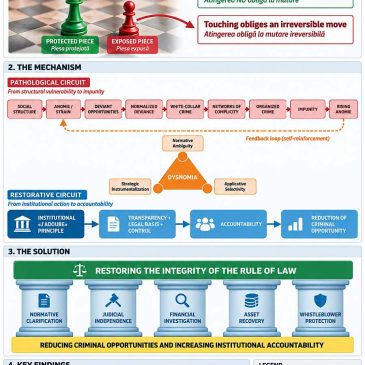
Attitudes and Values in Local Public Administration – The Need for National Security – The Positioning of Intelligence Services

Objectives: To analyse the link between public attitudes in local administration and the redefinition of national security in post-communist Romania (2000-2006).
Methods: An interdisciplinary approach combining quantitative analysis of national surveys (the PHARE-FMAPL project), qualitative focus groups, and legal-doctrinal analysis of security frameworks.

Analysis of cyber attacks such as APT (Advanced Persistent Threat) and ransomware

In the information society, cyber attacks launched upon the information technology infrastructure are increasingly diversified and complex. Cybercriminals or black hat hackers use a wide range of techniques, tactics and procedures to compromise computer systems. APT and ransomware attacks are two cyber security threats that many companies and government institutions face. Ransomware is a medium complexity attack, while APT is a high complexity cyber attack. The emergence of certain hybrid malicious programs (computer worm-ransomware) and the diversification of attack vectors represent new challenges for specialists and organizations.

The Killing Game – Martyrdom, Murder and the Lure of ISIS

Book Review: Mark Bourrie (2016). ISIS – Game of death – Martyrs, assassinations and fascination, Corint Publishing House, Bucharest. Original book title: The Killing Game – Martyrdom, Murder and the Lure of ISIS. Mark Bourrie’s work was also published in Romania, by the Corint Publishing House, in 2016. It is structured on 13 chapters and has 320 pages. The work falls within the scientific fields of security and intelligence studies. The theme addressed by Mark Bourrie is of global importance, as, nowadays, terrorism is a threat to human communities and states. The book is an up-to-date research on the issue and manifestation of terrorism in the world, with reference to the Islamic State of Iraq and the Levant (ISIS) terrorist organization and its activity.

The impact of DoS (Denial of Service) cyberattacks on a Local Area Network (LAN)

În cadrul acestui articol voi evidenția un modus operandi al hackerilor care lansează atacuri cibernetice de tip Denial of Service (DoS). Voi arăta teoretic cum pot fi realizate atacurile CAM Overflow și TCP SYN Flood, utilizând Kali Linux, o distribuție de Linux utilizată de criminalii cibernetici pentru a putea lansa atacuri de tip MitM (Man-in-the-Middle), atacuri DoS, observarea traficului dintr-o rețea de calculatoare etc. Hackerii pot afecta funcționarea dispozitivelor din rețeaua locală a unei organizații (server, router, switch etc.) prin trimiterea a mii de pachete/secundă către dispozitivul țintă. CAM Overflow este un atac prin care un hacker urmărește să supra-aglomereze tabela CAM a unui switch cu adrese MAC, iar TCP SYN Flood este un atac care poate fi lansat împotriva unui server din rețeaua de calculatoare.

Articles without specifying another CC license are licensed under CC BY-NC-ND.