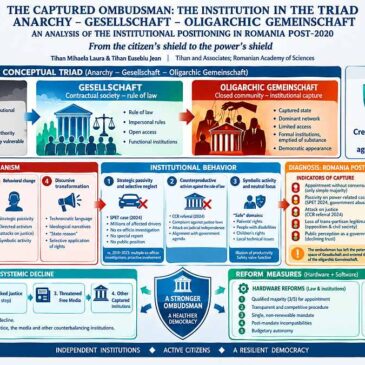
The Captured Sentinel: The Ombudsman Institution in the Anarchy – Gesellschaft – Gemeinschaft Triad. An Analysis of Institutional Positioning in Post-2020 Romania

This article examines the position and functioning of the Romanian Ombudsman institution through the lens of an extended triadic model of social integration: Anarchy (absence of order), Gesellschaft (contractual society based on rule of law), and Oligarchic Gemeinschaft (closed community based on institutional capture). The study employs a qualitative institutional analysis and case study methodology, integrating theoretical synthesis of the Hardware-Software model with critical examination of the Ombudsman’s activity in the post-2020 period.
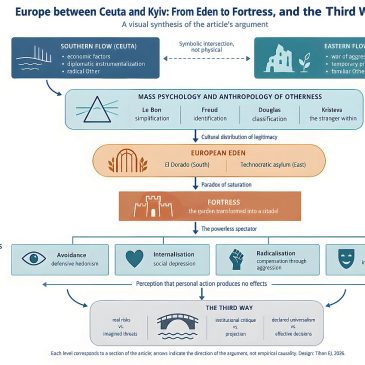
Europe between Ceuta and Kyiv: An Anthropological-Psychoanalytic Analysis of the Two Migratory Flows – Mass Psychology, Otherness, the European Imaginary, and the Helpless Spectator Syndrome

Psih. Mihaela Laura TIHAN[1], MSc, Psih. Eusebiu Jean TIHAN[2], MSc eusebiu.tihan@gmail.com [1] Tihan & Associates Romania, ORCID: 0009-0003-1820-1417 [2] Academy of Scientists of Romania, ORCID: 0009-0008-8316-3679   Abstract This article offers a psychological-anthropological and psychoanalytic interpretation of the symbolic intersection between two human movements oriented from different geographical directions: the South, illustrated by crossings toward Spanish territory around Ceuta, and the East, associated with people leaving Ukraine in the context of war. It does not assume that these movements are … Read More

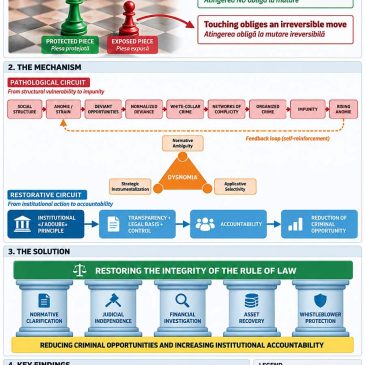
The Mechanics of the “Touched Piece” in State Capture: A Psychosociological and Anthropological Analysis of Impunity in White-Collar Crime in Romania

This article analyzes the phenomenon of institutional capture and systemic impunity within the Romanian judicial system, using as a heuristic metaphor and explanatory paradigm the chess rule “Pièce touchée” (the touched piece). Starting from recent data on criminal prescription in Romania, the study explores the causal chain transposed from psychological anthropology and the sociology of deviance: social anomie – deviance – social pathology – organized crime. It demonstrates how political elites and trans-sectoral networks use tactics of the “J’adoube” (I adjust) type to reconfigure the normative framework in favor of white-collar crime, transforming the act of justice from an impartial arbiter into an instrument of selective protection.

Articles published according to the current editorial policy